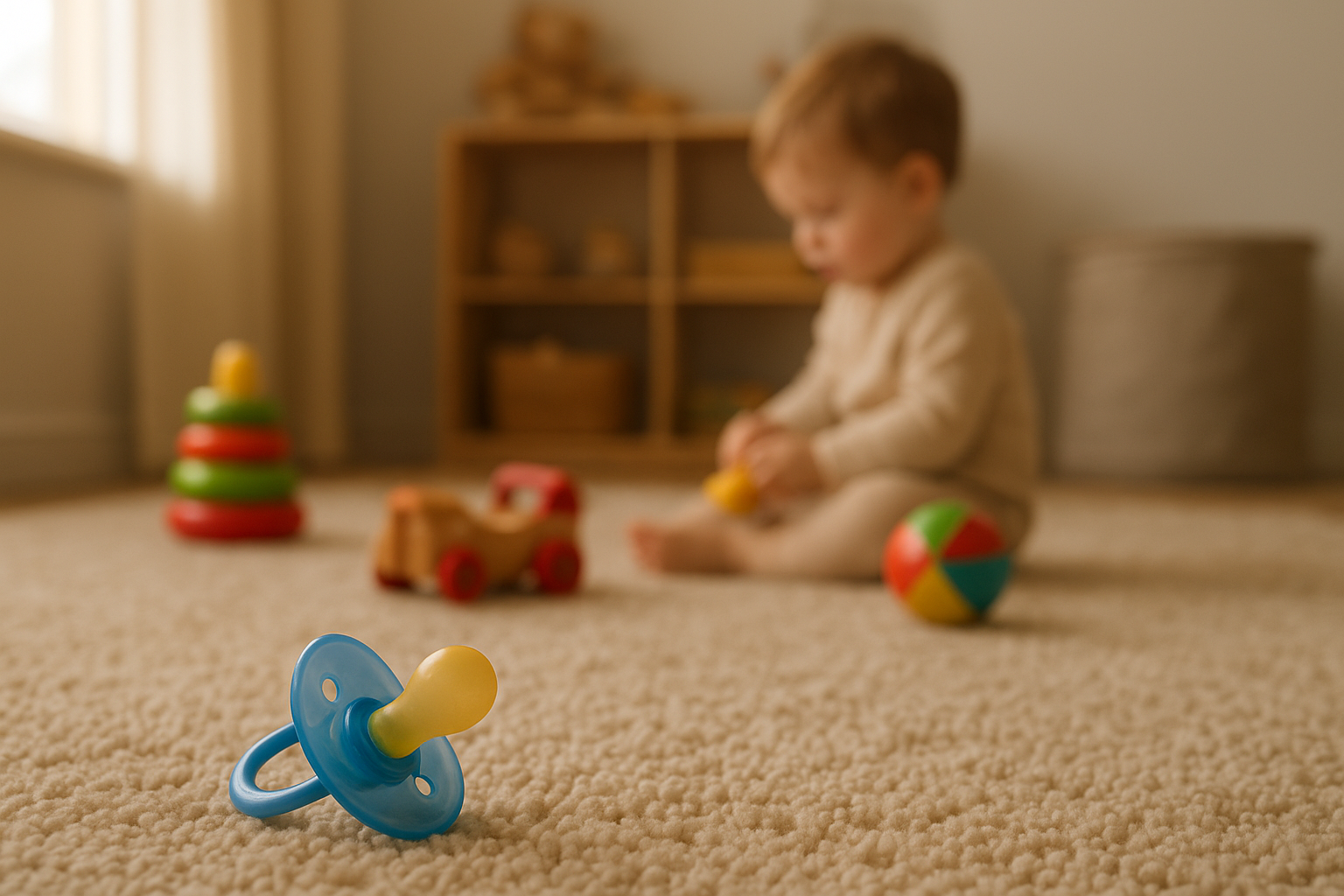
As a speech, language and feeding therapist, I find that dummy use is one of the top things I talk about with parents of young children; and most parents’ journey with their child’s dummy, started the same as mine, unintended.
As a mum to be, I did not plan on my child having a dummy; however, when we found ourselves with an infant needing unexpected medical interventions, the dummy became a necessary tool for feeding skill development, self-soothing and pain relief.
After that, the dummy was a regular fixture in our household. I knew however, that the day would come when my son’s use of the dummy would need to stop; and that is where the question sits, ‘When should a child wean off the dummy?’. Luckily for us, one night while sleeping, we had a visit from the ‘Dummy Fairy.’ She took all of the dummies in our house and in their place left a toy helicopter. For my son, this was a relatively easy way to transition away from the dummy; and although it is not always easy for children to say ‘good-bye’ to this part of babyhood, it is a necessary part of their development.
A Centuries Old Tradition
The use of pacifiers, or dummies, dates back over thousands of years when dummies made of clay, silver, pearl or coral, and sugar teats have been described.1 The oldest evidence of dummy use comes from Italy where archeologists found 3,000 year old clay objects shaped like pigs or frogs, with a hole in the mouth from which a baby could suck honey or sugar. Wealthy parents gave their babies dummies made out of gold, silver or pearl while babies from less affluent families had dummies made of wood or bone. Some dummies even doubled as soothers and a barrier to evil spirits!2
Today, dummies remain a common fixture in our baby culture with between 58% and 85% of children using a dummy at some point.3 There are good reasons to offer babies dummies in modern life including to support the development of feeding skills in pre-term infants, pain relief for infants undergoing a procedure, and reducing the risk of SIDS.4 However, there comes a point where the benefits no longer outweigh the risks, and it is time to wean from the dummy.
Complications of Dummy Use
The complications of dummy use can include difficulty establishing breastfeeding, increased risk of ear infections, and dental problems.3 Additional considerations from a speech, language and feeding perspective include speech differences and prolonged use of immature oral motor patterns in children with extended dummy use.
Speech differences seen in children with prolonged dummy use may be a result of limited practice with babbling and producing sounds due to increased time spent with a dummy in their mouth. Once a dummy is removed, there is evidence that these dummy driven speech sound errors may resolve as a child gets older.5 However, if a child’s speech sound errors are due to oral structural differences caused by prolonged dummy use, such as an open bite, the child may struggle with tongue placement to shape air flow for certain sounds and likely will need speech therapy and/or dental intervention.
As children start to wean onto solid foods and progress with their eating and drinking skills, they need to develop more mature oral motor patterns that support their ability to safely manage food and drink. The development of a mature chewing pattern and tongue lateralization skills as well as the ability to manage fluid from an open cup, is not supported by the forward resting tongue position and sucking pattern that children use when a dummy is in their mouth. Therefore, children with prolonged dummy use may struggle to manage solid foods and fluid from an open cup.
When to Stop using the Dummy
From a speech, language and feeding perspective, it is important to limit dummy use as a child approaches six months of age. When a child is actively learning to babble and put sounds together, they need to have their mouth free to practice these skills. As they wean onto solid foods, a child needs to develop more sophisticated movement patterns of their jaw and tongue which is discouraged by extended dummy use. Because of this, from six months of age onward, the dummy should only be used at bedtime.
Research shows that “…the risks (of dummy use) begin to outweigh the benefits around six to 10 months of age and appear to increase after two years of age.”3 This has led many people who work in paediatrics to recommend dummy use be stopped entirely by 12 to 18 months of age.
How to Stop Using the Dummy
There are several thoughts on how to wean a child off the dummy. As a parent, you know your child best and you have to do what works for your child and your family life. Some strategies that families have found helpful include:
- Offering an alternative soother, such as a teddy or blanket, and using parent cuddles and rocking as a way to sooth baby or toddler instead of offering a dummy.
- Removing the dummy during the day when their child is content and only offering the dummy when their child asks for it. Distraction techniques, such as suggesting a parent and child play a game or go for a walk, instead of immediately giving a child the dummy can also help.
- Making the dummy less appealing by putting a strong flavour on it, or cutting a hole in it (make sure your child is not able to bite off pieces of the dummy once a hole is cut).
- Gathering all of a child’s dummies and leaving them for the ‘Dummy Fairy’ to collect while the child is sleeping. Leave a special toy or teddy from the Dummy Fairy in place of the dummies for your child to find when they wake.
Regardless of what way you chose to wean your child off the dummy, make sure you are consistent with your new rules and recognise that if your child is over six months of age, they likely see the dummy as a form of security and comfort; so they may need extra cuddles and a bit more understanding during this time of transition.
If you would like more information about the use of dummies and the development of speech, language and feeding skills in children, please get in touch; and sign up for our newsletter if you would like future posts delivered directly to your inbox.
- Recommendations for the use of pacifiers. Paediatr Child Health. 2003 Oct;8(8):515-28. doi: 10.1093/pch/8.8.515. PMID: 20019941; PMCID: PMC2791559. ↩︎
- Dr Browns: The Strange History of Pacifiers ↩︎
- Hohman EE, Savage JS, Birch LL, Beiler JS, Paul IM. Pacifier Use and Early Life Weight Outcomes in the Intervention Nurses Start Infants Growing on Healthy Trajectories Study. Child Obes. 2018 Jan;14(1):58-66. doi: 10.1089/chi.2017.0177. Epub 2017 Oct 4. PMID: 28976781; PMCID: PMC5743033. ↩︎
- American Family Physician: Risks and Benefits of Pacifiers ↩︎
- Speech and Language UK Myth-Busting: Dummies ↩︎