

What is Postural Stability?
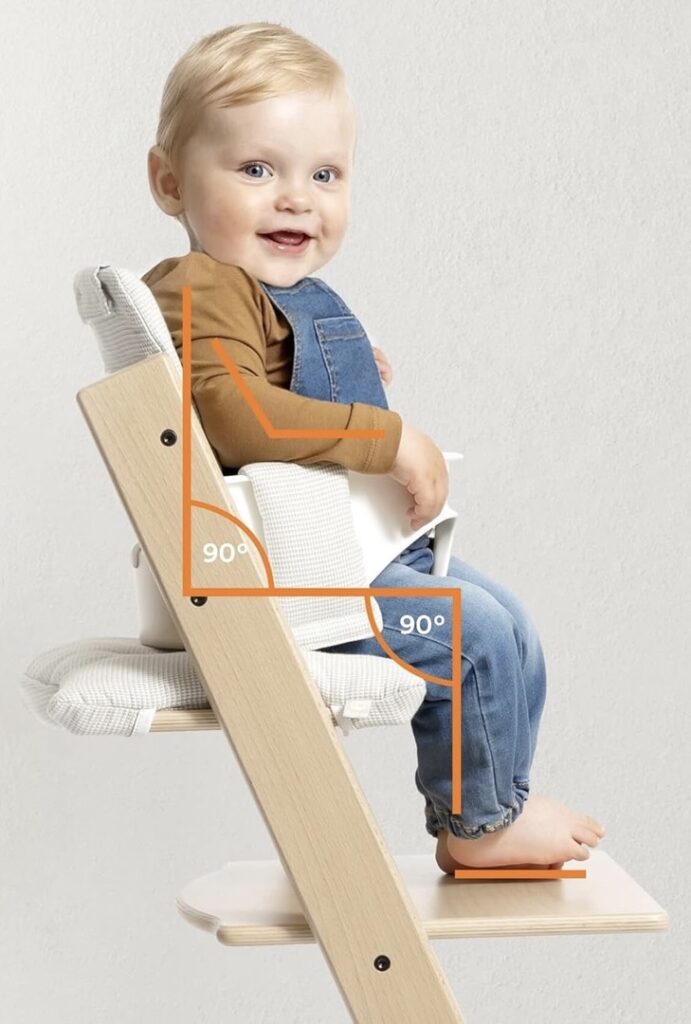
Postural stability is a person’s ability to maintain balance while keeping their body in the position needed to effectively complete a task. When eating solid foods, (i.e. from weaning onward), postural stability is achieved when a child (or adult) is seated at 90-90-90.
A person seated at 90-90-90 will have:
- their back resting against the back of the chair with a 90 degree bend at their hips,
- their knees bent at 90 degrees over the edge of the seat of the chair, and
- their feet resting flat on a surface so there is a 90 degree bend in their ankles.
Once your child is seated at 90-90-90, ensure the table (or tray) is positioned between their belly button and breast level.
Now your child is ready to eat!
Why is Postural Stability Important for Eating?
There are several reasons postural stability facilitates better feeding and safer eating for children (and adults!):
- When our big muscles and body are stable, our brain is able to focus on using our small muscles. These small muscles are what we use to feed ourselves, as well as bite, chew and swallow our food.
- Head stability, which is necessary for good jaw control, is directly influenced by the stability of a person’s pelvis and trunk. A child positioned at 90-90-90 has the head stability needed to safely bite, chew and swallow food.
- Postural stability supports better respiratory function, both for breathing and coughing (which is a key way we protect against choking).
- A child who is stable and comfortable in their seat at the table, is more likely to remain at the table for the duration of the meal (this supports a child to explore new foods, practise self-feeding skills, and learn about the social aspects of a family meal).
Signs a Child may have Difficulty with Postural Stability
- Slouching while sitting or sliding out of the chair.
- Constantly moving or fidgeting in their chair (i.e. ‘they can’t sit still’).
- Using a hand on the side of a chair to hold themselves up or supporting their head with their hand with their elbow on the table.
- Joint locking (extending their joints so they are stiff and ‘fixed in place’ to help their body remain stable).
- Preferring to stand or move around while eating.
Seating Recommendations
There are several baby and toddler seats on the market, unfortunately many of them do not position a child in 90-90-90. Although they can be a big investment, the best child seats for mealtimes are fully adjustable (i.e. the height of the seat, the height of the foot rest and the back-to-front position of the seat) and allow your child to sit up at the family dining table (instead of using a tray). Young children grow quickly and their mealtime seating arrangement needs to be adjusted about every three months to keep them in a 90-90-90 position; a fully adjustable seat will allow you to do this from 6 months through to adulthood (yes, some of these chairs can be adjusted to fit an adult!).
If you already have invested in a mealtime chair and you are finding that it is not quite right, adjustments can be made. Try…
- A firm cushion against the back of the chair as an extra backrest if the seat is too deep and your child cannot achieve a 90 degree bend at their hips and knees.
- A firm cushion on the seat of the chair if the seat is too low and your child cannot comfortably sit with the table between their belly button and breast level.
- A foot stool on which your child can rest their feet if their feet are dangling, or use books or a box to build up the chair’s footstool if it is too low.
- A no skid mat on the seat if the seat is slippery and your child regularly slips forward.
Careful consideration of your child’s seating position for mealtimes can make a big difference!
If you would like more information about children’s feeding, please get in touch. Follow us on Facebook for more speech, language, and feeding tips, and sign up for South Lakes Speech & Language Therapy’s newsletter if you would like new posts sent directly to your inbox.
Information adapted from the SOS Approach to Feeding
Please note that this article is for information purposes only and was written with typically developing babies and children in mind. If your child has a medical or developmental condition that puts them at increased risk for feeding issues, please speak with your child’s healthcare provider about positioning during feeding and any eating, drinking or swallowing concerns.