For many young children learning to talk, words don’t always sound like the adult version; “sun” might sound like “thun” or “zoo” might become “thoo.” These small differences in pronunciation are often called lisps, and in many instances are a normal part of speech development.
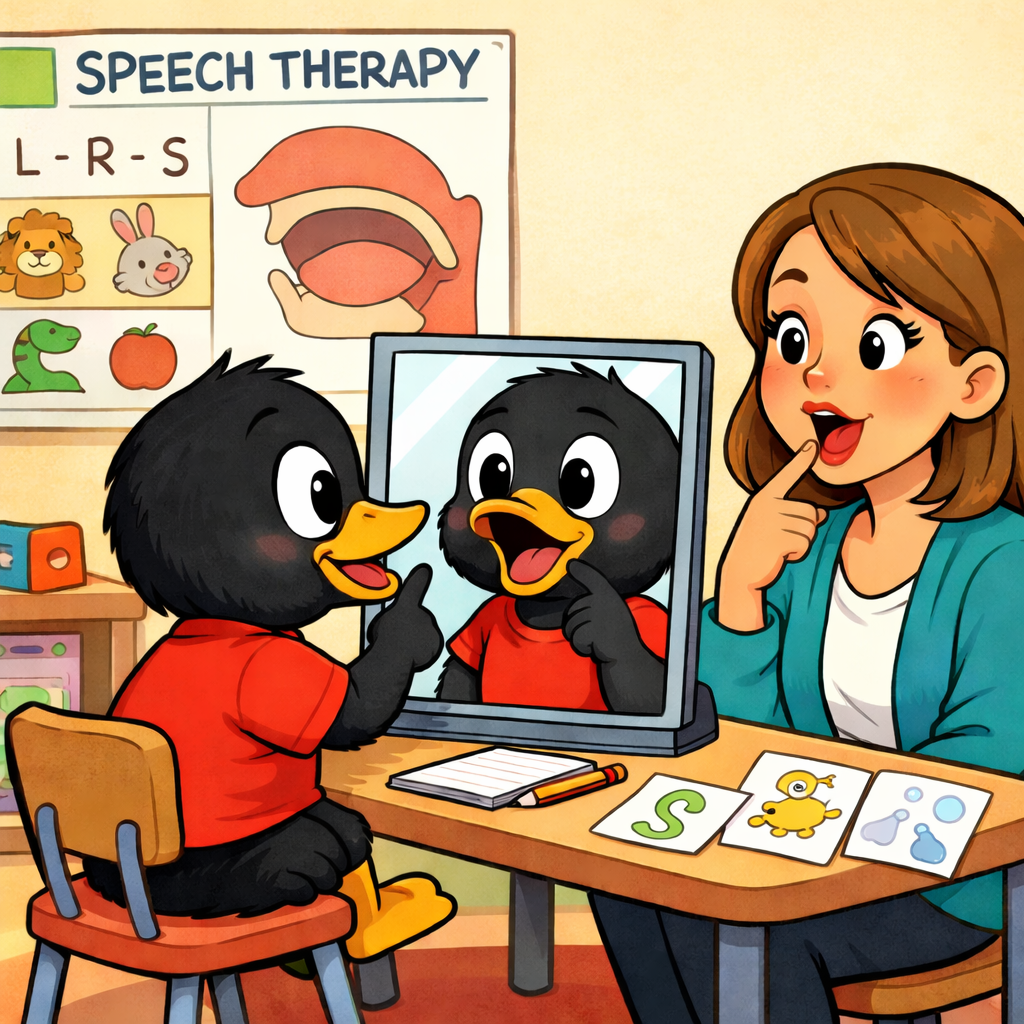
Daffy Duck has one of the most recognisable speech patterns of any cartoon character and this is in part down to his lisp, but what exactly is a lisp (and what would Daffy Duck sound like if he had speech therapy?!)?
What is a Lisp
A lisp occurs when the tongue is in the wrong position when saying the ‘s, z, sh, ch, zh and/or dg’ sound(s). It is traditionally thought of as slushy speech, but depending on tongue position can have a few different sound qualities.
Different Types of Lisps
There are four types of lisps. The strategies your speech and language therapist uses to help correct your child’s lisp may differ based on the type of lisp they have.
- Interdental Lisp – The tongue protrudes between the front teeth and the lisped sound(s) may sound like your child is saying ‘th’. An interdental lisp is a normal part of speech development for some children and should resolve by 4.5 years of age.
- Dentalized Lisp – The tongue pushes against the front teeth and the lisped sound(s) may sound like your child is saying a cross between ‘t’ and ‘th.’ A dentalized lisp is a normal part of speech development for some children and should resolve by 4.5 years of age.
- Lateral Lisp – Sound escapes along the sides of the tongue and the lisped sound(s) are perceived as ‘wet or slushy’. A lateral lisp is not a normal part of speech development at any age.
- Palatal Lisp – The midsection of the tongue comes in contact with the soft palate when saying the lisped sound(s) and the quality is ‘muffled and slushy’. A palatal lisp is not a normal part of speech development at any age.
What Can I Do to Help Correct My Child’s Lisp?
- Whenever possible, get face to face with your child when speaking with them, so they can see how you are making speech sounds.
- Repeat what your child says, emphasising correct sound production.
- If your child is using a dummy, infant bottle and/or spouted cup, try to reduce or eliminate use of these.
- If you are concerned about your child’s lisp, seek advice from a speech and language therapist.
Adapted from Bowen, C. (2011). Lisping: When /s/ and /z/ are hard to say.
If you would like more information about speech sounds, please get in touch. Follow us on Facebook for more speech, language and feeding tips, and sign up for South Lakes Speech & Language Therapy’s newsletter if you would like new posts sent directly to your inbox.