As children, my brother and I always baked Christmas cookies, and on Christmas Eve we would chose our favourites to leave out on a plate for Santa (next to some carrots for his reindeer of course!). Although there were several versions of Christmas cookies that we baked throughout the years, Santa’s Thumbprints always remained a favourite and always made it to the plate we left out for Santa!
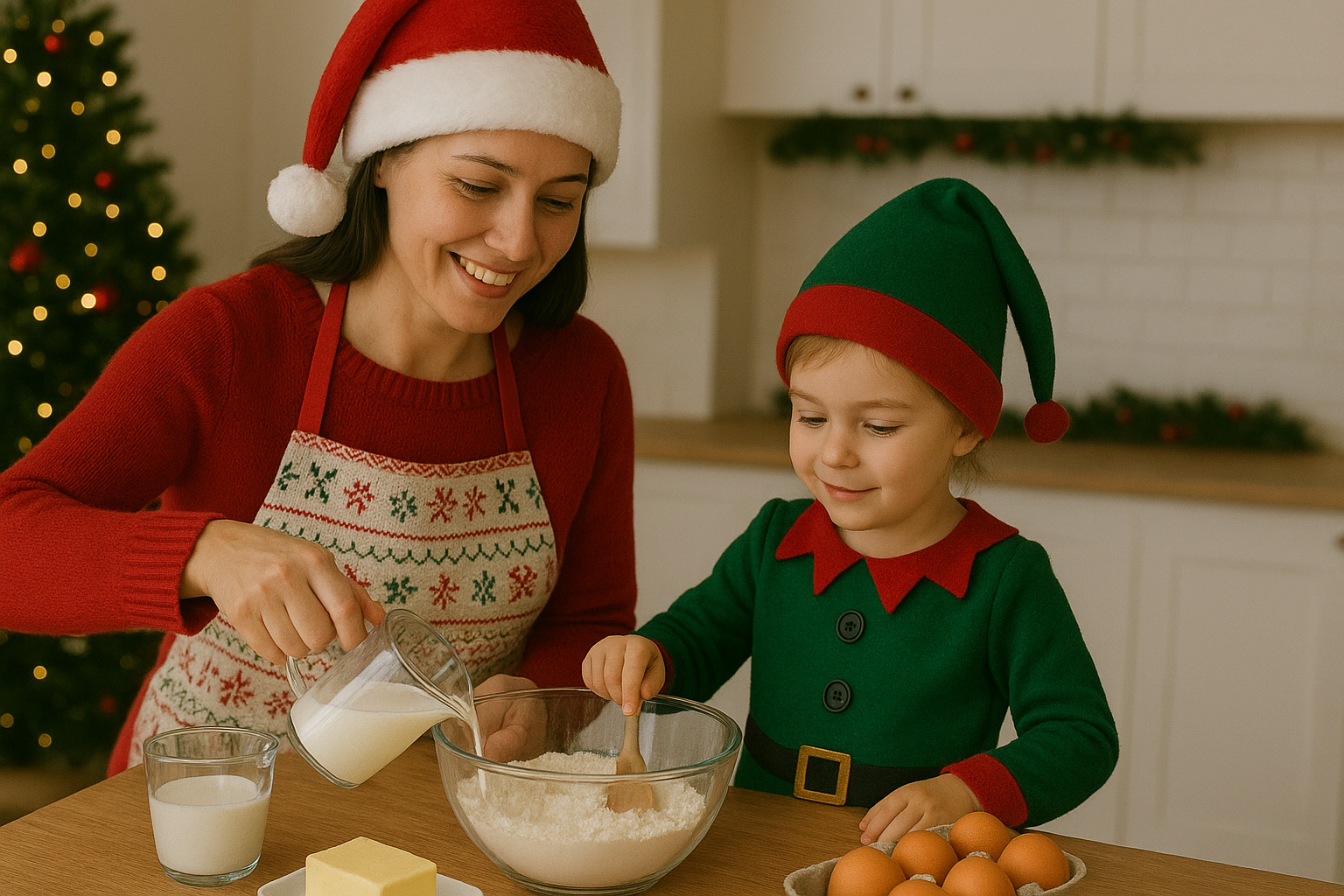
As a parent, I have carried on this tradition at my home and Santa’s Thumbprints are still top of the list. Baking as a child, I did not appreciate all the learning that came along with time in the kitchen, but as an adult, I realise what a wonderful way cooking together can be to support a child’s language development and learning about food! If you are looking for a fun, festive way to support your child’s communication and mealtime skills, enjoy time together in the kitchen baking Santa’s Thumbprints.
Speech and Language Learning through Baking
Learning becomes more meaningful when it happens in the real world, and the kitchen is a fantastic place to build on your child’s speech and language skills. You might be surprised at all the communication skills you can target while baking together.
- Vocabulary – Baking together naturally exposes your child to new words such as recipe, measure, beat, finely chopped, fluffy, thumbprint, etc.
- Basic Concepts – Time in the kitchen together provides opportunities to introduce basic concepts including: hot/cold; full/empty; dirty/clean; wet/dry; big/little; heavy/light; shiny/dull; first/next/last; and more.
- Verbs – Baking action words such as stir, whisk, pour, heat, etc. can be practiced throughout your baking activity in present, past and future tense forms.
- Following Directions – Baking is a multi-step activity and you can use time in the kitchen to support your child’s ability to follow one-, two- and multi-step directions.
- Let’s get a spoon.
- Get a spoon and put it in the bowl.
- Get a spoon and put it in the bowl, then pour the sugar in the bowl.
- Understanding and Answering Questions
- Who baked the cookies?
- Where is the cookbook?
- What did you use to mix?
- When do we turn on the oven?
- How many cookies did we make?
- How did we open the tin?
- Speech Sounds – Practice sounds your child has not yet mastered while baking.
- ‘s’ – salt, sugar
- ‘s’ blends – scoop, stir
- ‘l’ – liquid, let cool
- ‘sh’ – sugar, chef
- ‘r’ – roll, press
- ‘ch’ – chop, inch
- ‘th’ – thumbprint
- Narrative Skills – Using narrative refers to a child’s ability to tell about a sequence of events in the correct order with a clear beginning, middle and end. When you finish baking, have your child re-tell you the story of what you did in the kitchen together.
- Executive Functioning – Baking is a multi-step process that requires higher level thinking and communication skills including organisation, cognitive flexibility, working memory, attention, and planning.
Mealtime Learning through Baking
For children who enjoy eating as well as for those who struggle with eating or are ‘picky eaters,’ time around food in a no pressure environment, such as baking, supports the development of skills needed to manage food at the table.
To help your child build positive food connections, when baking together focus on:
- Sensory Exploration – Encourage your child to smell, touch, and look at the food without pressure to it eat. Use vocabulary such as soft, crunchy, firm, and colour words to describe what you feel and see.
- Being Okay with Food Mess – Baking and eating are messy at times. Practice with food on hands and clothes while baking helps children to be comfortable with food mess while eating.
- Food Choices – ask your child to decide what flavour jam to put in the thumbprint, decide whether every cookie should be rolled in nuts, etc.
- Enjoying Time Together around Food – Part of building positive food connections is enjoying time around food. When your child has fun baking with you, that supports their development of a positive association with food. Be silly, smile and laugh together while you create your tasty treat.
Santa’s Thumbprints Recipe
Ingredients:
- 300g butter
- 175g brown sugar
- 1 egg
- 1 tablespoon vanilla
- 340g uncooked oats
- 275g plain flour
- 250g finely chopped walnuts*
- 230g jam (any flavour – my favourite is raspberry!)
* If you (or Father Christmas) has a nut allergy, leave out the nuts; the nut free version is yummy too!
Directions:
- Heat the oven to 180°
- Beat the butter and sugar until fluffy then add in the egg and vanilla.
- Next add in the oats and flour and mix well.
- Form into one inch balls.
- Roll the balls in the nuts then place on a baking sheet.
- Press the centre of the ball with your thumb then fill the ‘thumbprint’ with jam.
- Bake at 180° for 8 to 10 minutes.
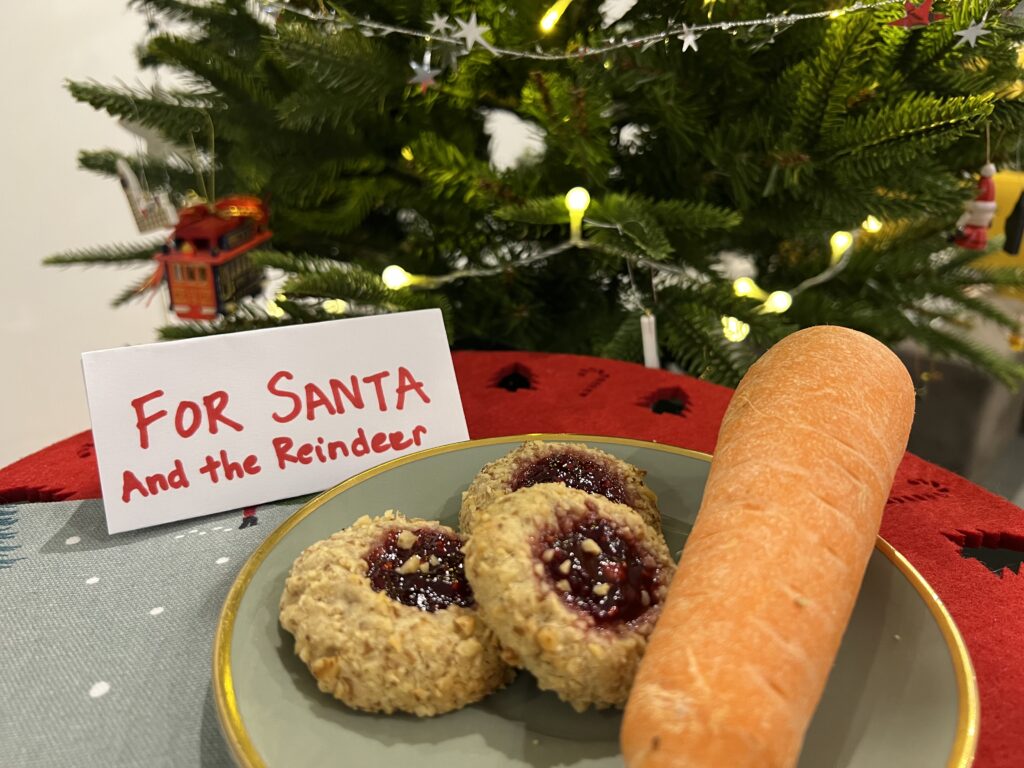
I hope you enjoy your Santa’s Thumbprints! Happy holidays, and happy baking with your child!
If you would like more information about children’s communication or feeding, please get in touch. Follow us on Facebook for more speech, language and feeding tips, and sign up for South Lakes Speech & Language Therapy’s newsletter if you would like new posts sent directly to your inbox.