
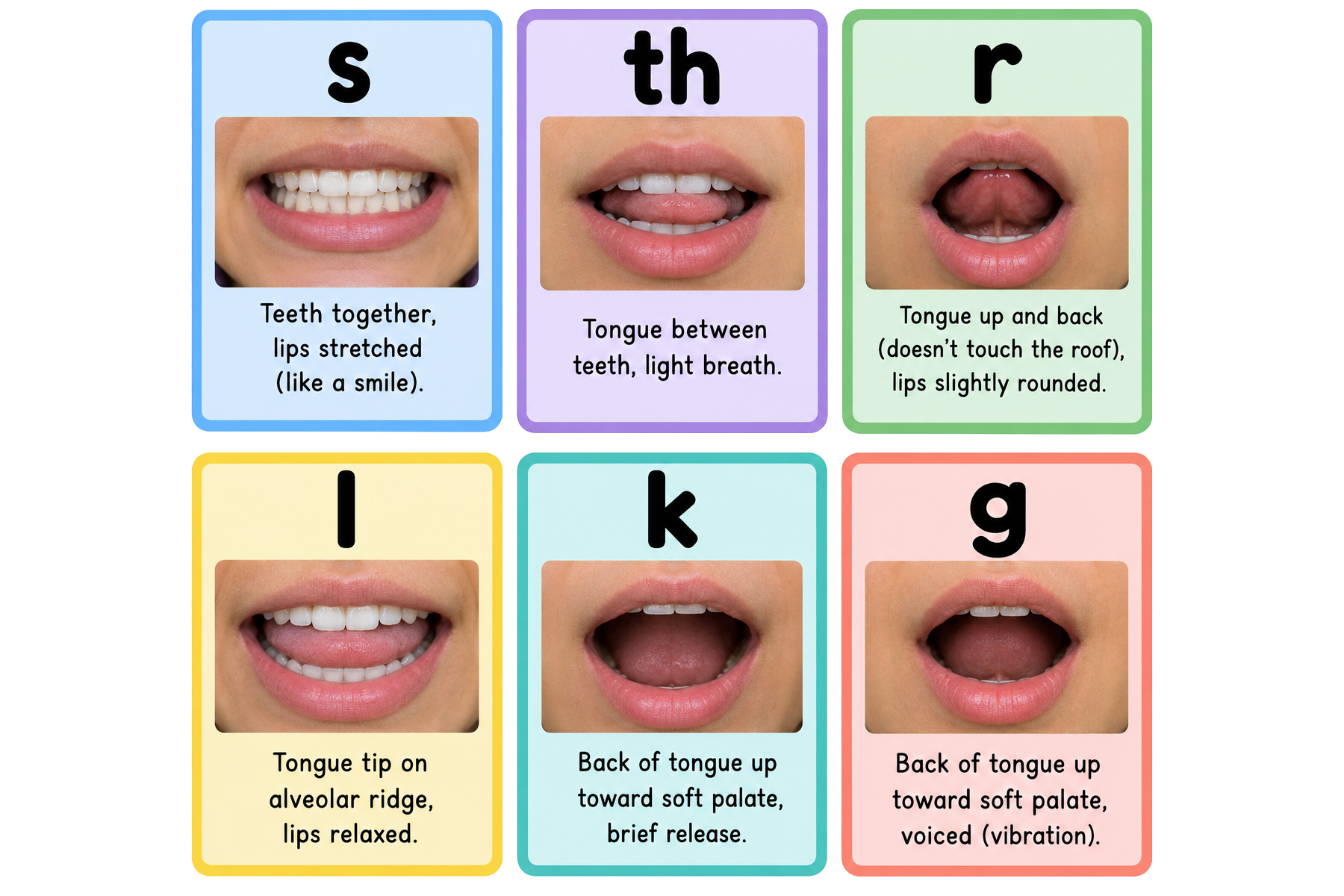
Traditional articulation therapy is usually the therapy approach of choice for children with mild or specific speech sound errors. It is a structured, step-by-step approach that helps children learn how to produce speech sounds accurately and confidently. From teaching where to place one’s tongue and lips to practising sounds in words, sentences and everyday conversations, traditional articulation therapy follows a production hierarchy, and your child’s Speech and Language Therapist (SLT) will support your child to move through the hierarchy using motor learning principles.
Charles Van Riper is credited with developing what SLTs consider the traditional articulation therapy approach in 1939. Although the basic principle remains the same today, there have been some adaptations along the way, and your child’s SLT may add in elements of other articulation approaches to support your child’s specific speech needs. For a guideline of what to expect if your child is receiving traditional articulation therapy and how to support their speech at home, keep reading. 😀
Stages of Traditional Articulation Therapy
For children following the traditional articulation therapy approach, you can expect them to progress through the following stages:
1. Listening
You child will need time practising listening to their target speech sound. They will need to be able to identify good and poor productions when the sound is said by their therapist and later on when they say their target sound themselves.
2. Isolation
Your child will practise saying their speech sound in isolation. As a part of this learning, your child’s SLT will directly teach your child the motor movements needed to say their target sound correctly. This includes lip and tongue placement as well as whether they need to turn their voice on or off to make the sound.
3. Add a Vowel
Once your child is able to produce their sound in isolation, they will spend time practising their sound paired with a vowel to make non-sense and real words. For example, if your child’s target sound is /t/ they may practise:
- tee
- tai
- tie
- toe
4. The Word Level
Next your child will progress to the word level and repeatedly practise their sound at the start of many different words. At this stage, your SLT will not ask your child to put the word in a sentence; saying the word correctly with their target sound at the start of the word is the goal.
5. The Phrase Level
At the phrase level, your child will practise their new sound at the start of a word in a phrase. The phrase will remain the same and only the target word changes. For example, if your child’s target sound is /r/, practise at the phrase level may look like:
- I see a rat.
- I see a rock.
- I see a road.
6. The Sentence Level
At the sentence level, your child will practise their new sound at the start of a word in a sentence. The sentence will change with each target word. For example, if your child’s target sound is /r/, practise at the sentence level may look like:
- I see a rat.
- The rock is on the floor.
- A car drives on a road.
7. Reading
Children who are reading, may be asked to practise their sound while reading a short passage. Your child’s SLT will have your child look through the passage first and highlight all the words that start with their target sound then read the passage out loud with a focus on good production of the their target sound.
8. Conversation
Your child using their speech sound correctly in conversation is the end goal. When your child reaches this stage, it will be important that all the adults in your child’s life (parents, teachers, grandparents, etc.) know what speech sound they are working on and support your child to remember their sound when talking.
A lot of the work at the conversation level happens outside of the speech therapy session, and feedback from you and your child’s teacher about how well your child is generalising their sound in conversation is what will let your child’s SLT know when the sound is mastered.
Things to Keep in Mind
- Practise, practise, practise! Children need a lot of practise to change a speech pattern, so be prepared to practise regularly at home and do your speech homework. Just 10 minutes a day of focused speech practise will make a huge difference in your child’s speech sound learning!
- Traditional articulation therapy focuses on a target speech sound in one position of a word at a time (initial, medial or final). Therapy usually starts with sounds at the start (or initial position) of words, and once a child is consistently saying the target sound correctly in the initial position of words, traditional articulation therapy moves to learning that sound at the end and middle of words. This is important to keep in mind when practising with your child. If, for example, your child is at the sentence level and their target sound is initial /k/ and the word they are practising is ‘key,’ they may say the sentence “the key is in the lock.” Although the /k/ sound occurs in two places in the sentence (key and rock), the target sound is initial /k/, so it is only expected that your child produce a good /k/ in the word ‘key’.
- Until your child is nearing the conversation stage of traditional articulation therapy, the production focus is usually only on a child’s target sound in a single target production. For example, at the early sentence level, if your child’s target sound is initial /s/ and the word they are practising is ‘soup.’ They may say the sentence “I eat soup from a spoon.” Although the /s/ sound occurs in two places in the sentence (soup and spoon), the target word is soup, so it is only expected that your child produce a good /s/ in the word ‘soup’. As your child becomes more proficient at the sentence level, your SLT may ask them to practise two target words in a single sentence (“The soup is sour”) and certainly by the time your child gets to the conversation level, the aim is to hear a good production of the target sound in all words.
- There is a developmental order to speech sound acquisition, and with traditional articulation therapy, SLTs usually only target developmentally appropriate sounds (i.e., sounds that should be in your child’s sound system based on their age). However, there are instances where it is appropriate to address later developing sounds; your child’s SLT will discuss with you whether this is appropriate for your child.
- Change takes time. It is difficult to change a habit (can you imagine how long it would take you to change your conversational speech if I asked you to say /g/ every time you naturally would have said /d/?). Although it is impossible to predict how long it will take a child to meet their therapy targets, it will take time. The best way you can help your child is regular practise with the homework activities your SLT gives you.
If you would like more information about speech development in children or speech therapy with South Lakes Speech & Language Therapy, please get in touch. Follow us on Facebook for more speech, language and feeding tips and sign up for South Lakes Speech & Language Therapy’s newsletter if you would like new posts sent directly to your inbox.