
Do you find mealtimes with your child challenging, and are you left wondering, “How do I get my child to eat”?
One of my favourite mealtime approaches is Ellyn Satter’s Division of Responsibility. It sets out the responsibilities of the parent and the responsibilities of the child during mealtimes, and by clearly outlining parent and child roles, it aims to reduce frustration on the part of the parent and the child, increase enjoyment of time together at the table, and promote a positive feeding relationship.
In its simplest form, the Division of Responsibilities helps parents and children establish the following mealtime roles:
The Parent’s Responsibilities
- What: The parent sets the menu and decides what foods will be offered.
- When: The parent sets consistent meal and snack times and offers appropriate food at those times.
- Where: The parent determines the mealtime environment where food will be offered.
The Child’s Responsibilities
- How Much: The child decides how much to eat of the food that is offered.
- Whether: The child decides whether or not to eat the food offered.
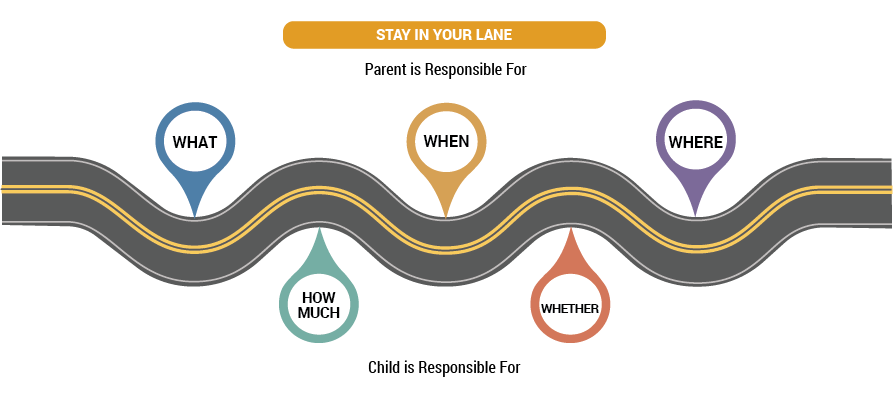
Stay in Your Lane
“Think of feeding your child like this: You’re in one lane, your child is in the other. The Division of Responsibility in Feeding is the double yellow line between you—it sets clear boundaries and keeps things on track.”1
The Division of Responsibility is a responsive feeding approach that can be used from infancy through adolescence. It is intended to support typical feeders develop mealtime skills and avoid the power struggle that many of us find ourselves in at the table with our children.
Feeding Therapy with South Lakes Speech and Language Therapy
Feeding Therapy with South Lakes Speech & Language Therapy is individualised based on your child’s needs. When supporting children who are picky eaters and/or have medical, developmental, or other feeding difficulties, the basic principles of the Division of Responsibility frequently form the foundation of our mealtime recommendations with therapeutic interventions, specific to an individual child’s needs, layered on top of these principles.
If you have questions about feeding your child or feeding therapy with South Lakes Speech & Language Therapy, please get in touch. Follow us on Facebook for more speech, language and feeding tips and sign up for South Lakes Speech & Language Therapy’s newsletter if you would like new posts sent directly to your inbox.