
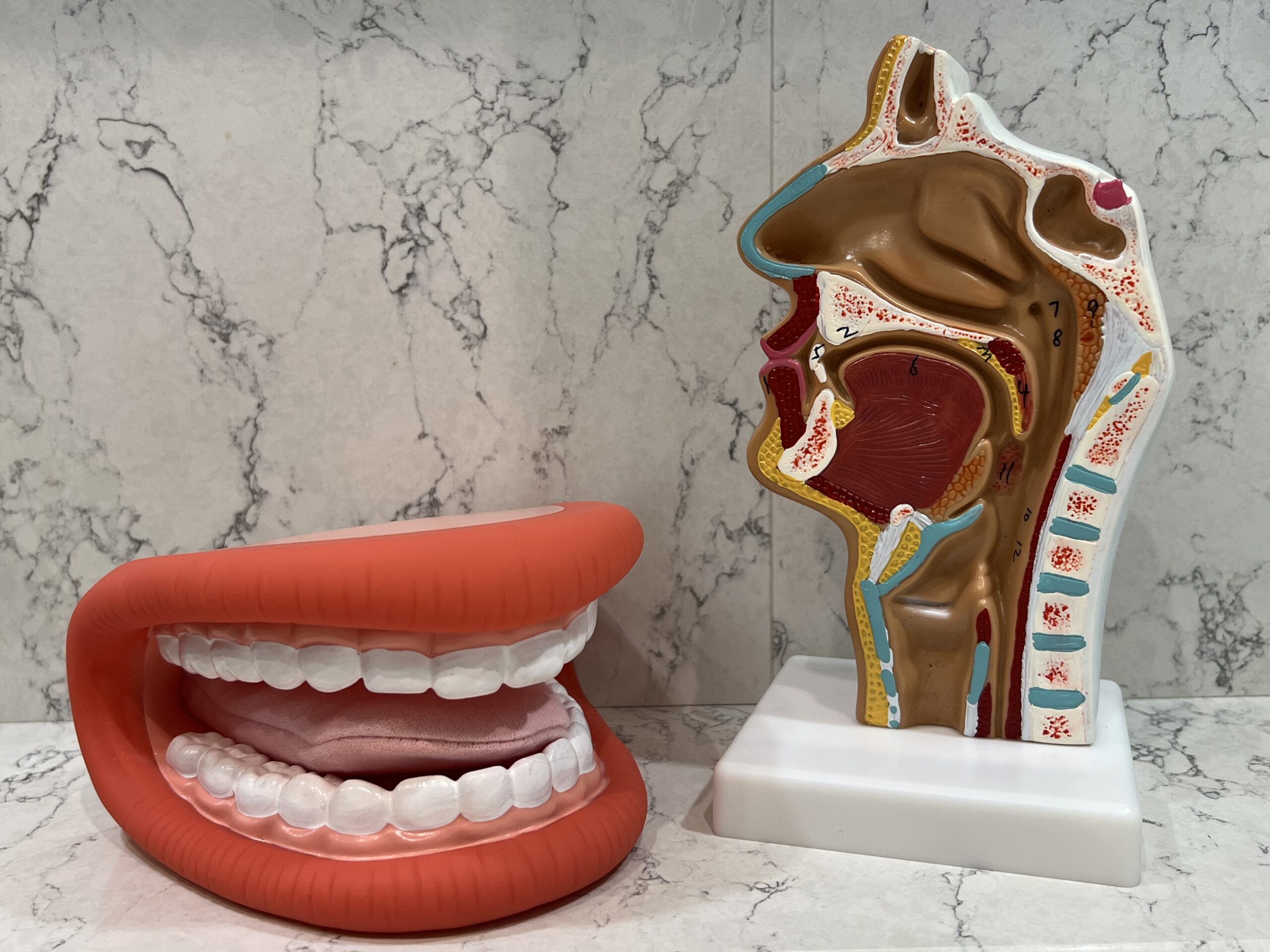
On average, humans swallow nearly 600 times a day;1 although, it is a process most of us don’t think, or know, much about. However, as a feeding therapist, I spend a good portion of my working week thinking about and explaining to children and their parents the normal swallow process and where things can go wrong.
Below is a whistle-stop tour of the anatomy of a swallow. The picture above is of Priscilla and Mr. Mouth Model, my two assistants when explaining about eating, drinking and swallowing (and speech!).
The Stages of Swallowing
I. Oral Preparatory Stage
During the first stage of swallowing, food is chewed and mixed with saliva to form a cohesive, soft and slippery bolus which can easily be swallowed without injuring the oesophagus.
In addition to helping turn food into a shape and consistency that is easily swallowed, saliva in the mouth starts the process of digestion, aids in tasting, and helps protect the teeth from decay.
II. Oral Phase
During the oral phase, the bolus is propelled to the oropharynx (back of the mouth) by the tongue. This action stimulates sensory receptors that trigger the swallowing reflex.
III. Pharyngeal Phase
The entry of the bolus into the oropharynx triggers sensory receptors in the soft palate (roof of the mouth toward the back) and back of the throat that activate the swallowing centre in the brainstem. This triggers a series of coordinated actions to protect the airway and move the bolus toward the stomach:
- Brief inhibition of respiration
- Elevation of the soft palate (to stop food from going into the nasal cavity).
- Depression of the epiglottis (flap behind the tongue, above the throat) – the epiglottis moves down and horizontal to close off the trachea or windpipe (passage to the lungs).
- Adduction of the vocal folds (flexible bands of tissue at the opening of the trachea) -the vocal folds come together as an extra protection against food going toward the lungs.
- Opening of the upper oesophageal sphincter (muscular ring at the opening of the oesophagus or food pipe). This allows the bolus to move toward the stomach.
IV. Oesophageal Phase
Once the bolus is in the oesophagus, the vocal folds open and the epiglottis and soft palate move back to their resting positions. The upper oesophageal sphincter closes to prevent reflux and air going to the stomach, and normal breathing continues.
Swallowing Facts1
Some fun facts about human swallowing 🙂
- Humans swallow around three times an hour during sleep, once per minute while awake and even more often during meals.
- Swallowing uses 26 muscles.
- Humans produce between 0.5 and 1.5 litres of saliva a day.
- Saliva is 99% water and 1% protein and salts.
- With each swallow we hold our breath for around one second.
- Once swallowed, it takes the bolus about 9 seconds to reach the stomach.
If you have questions about children’s feeding or concerns for your child, please get in touch; and please sign up for the South Lakes Speech & Language Therapy newsletter if you would like future posts sent directly to your inbox.
Please note that this article is for information purposes only. If you have swallowing concerns for your child, please speak to their medical provider and/or seek out an assessment with a qualified paediatric feeding therapist.
- Norfolk and Norwich University Hospitals NHS Foundation Trust Speech & Language Therapy,
Speech Pathology Australia,
Iorgulescu G. Saliva between normal and pathological. Important factors in determining systemic and oral health. J Med Life. 2009 Jul-Sep;2(3):303-7. PMID: 20112475; PMCID: PMC5052503. ↩︎